What Meta’s 1 October Pricing Changes Could Mean for RCS
Meta’s WhatsApp pricing changes coming on 1 October 2026 could have implications well beyond WhatsApp itself. As the cost of customer conversations changes, businesses may have a stronger reason to reassess the role of RCS.

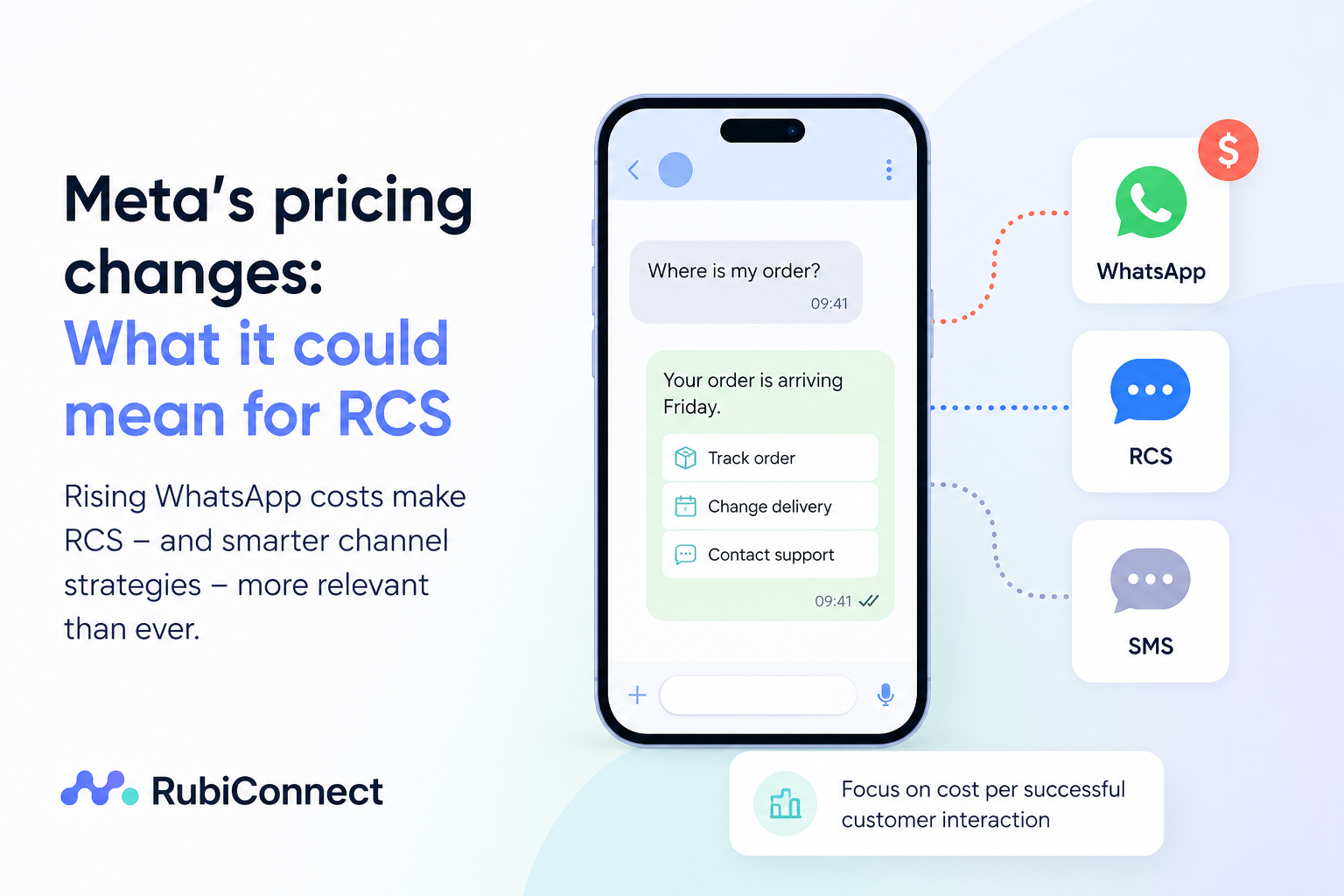
From 1 October 2026, Meta is changing the economics of WhatsApp Business messaging. Service messages that are currently free within the customer-service window will become chargeable, while utility messages sent during an open customer-service window will also be billed.
For businesses using WhatsApp at scale, this is more than a pricing adjustment. It could influence how companies design their customer communication strategies — and make RCS increasingly relevant.
It also highlights the value of having access to multiple messaging channels through a single platform such as RubiConnect.
Why the change matters
Customer-service conversations rarely involve just one outbound message.
Consider an online retailer dealing with a delayed delivery. A customer might ask for an update, after which the business sends the new delivery date, a tracking link, alternative delivery options and a confirmation. One interaction can therefore generate several outbound messages.
Under the new WhatsApp model, each of those messages can carry a cost.
For businesses handling hundreds of thousands or millions of interactions, the financial impact could become significant. The key question is no longer simply:
“What does a WhatsApp message cost?”
It is:
“What does it cost to complete a customer interaction?”
That distinction makes the economics of alternative messaging channels increasingly important.
Why RCS deserves a closer look
RCS for Business already supports different billing models. Outside the US, conversational agents can be billed based on a 24-hour conversation, rather than charging separately for every message exchanged during that conversation.
For multi-step customer-service interactions, that can create a different cost structure.
Returning to the delivery example, a customer could ask for an update, receive an explanation, select a delivery option and receive confirmation. With a per-message model, costs increase with every outbound message. Under a conversational RCS model, the economics can instead be structured around the conversation.
This does not automatically make RCS cheaper. Pricing varies by market, carrier, messaging provider and communication type. Businesses need to compare actual rates and traffic patterns rather than relying on headline pricing.
But the difference in commercial models makes RCS increasingly worth evaluating alongside WhatsApp.
Beyond cost: a richer customer experience
The RCS opportunity is not purely financial.
RCS was designed to support richer business interactions than traditional SMS, including rich cards, images, suggested replies and suggested actions.
For example, rather than sending several separate messages containing delivery information and individual links, a business could present the relevant information in a single interactive experience:
Your order is arriving Friday
[Track order]
[Change delivery]
[Contact support]
This can reduce friction for the customer while potentially reducing the number of individual messages required to complete the journey.
The opportunity is not “WhatsApp versus RCS”
It would be too simplistic to conclude that businesses should simply move from WhatsApp to RCS.
WhatsApp, RCS and SMS are communication channels, each with different levels of reach, customer adoption, functionality, availability and commercial economics.
The strategic opportunity is to have access to these channels and choose the most appropriate one for different customer journeys and use cases.
A business might use WhatsApp where customers are already highly engaged, RCS for rich transactional or conversational experiences, and SMS where broader reach or fallback capability is required.
This is where a multichannel platform such as RubiConnect becomes relevant.
Where RubiConnect fits
RubiConnect brings multiple communication channels together within one platform, including WhatsApp, RCS and SMS.
This means businesses can manage their messaging strategy without having to build completely separate customer communication environments for every channel.
The benefit is not that RubiConnect automatically decides which channel to use for every individual message. Rather, it provides businesses with access to multiple channels within the same platform, making it easier to develop and manage a broader messaging strategy.
As the economics and capabilities of individual channels evolve, businesses can evaluate where each channel makes the most sense.
For example:
- WhatsApp may be particularly valuable where customers already use the channel extensively.
- RCS may be attractive for rich, interactive and conversational customer journeys.
- SMS can continue to provide broad reach and an important fallback option.
The customer communication strategy can therefore evolve without requiring the business to adopt a completely different platform for every channel.
A new way to measure messaging
The October change also reinforces the need to move beyond cost per message as the primary metric.
A more meaningful measure is:
cost per successful customer interaction.
That calculation should consider messaging costs alongside reach, engagement, automation, conversion and customer experience.
A channel with a higher message price may still be more efficient if it delivers better engagement or resolves interactions more effectively. Conversely, a cheaper channel may have limited value if customers do not engage with it.
Businesses should therefore evaluate channels based on the complete customer journey, rather than looking at the price of an individual message in isolation.
What businesses should do before October
Companies that rely heavily on WhatsApp should take five practical steps:
1. Measure outbound messages per conversation
Understand how many messages are typically required to resolve different types of customer interactions.
2. Model the October impact
Apply the new WhatsApp pricing to actual service-message volumes and customer journeys.
3. Identify high-volume workflows
Focus on journeys where multiple outbound messages are routinely required. These are likely to have the greatest potential impact from the pricing change.
4. Benchmark RCS
Compare RCS pricing, availability, reach and functionality in the markets that matter to the business.
5. Review the channel strategy
Consider which customer journeys are best suited to WhatsApp, RCS or SMS — and whether managing these channels through a single multichannel platform could simplify the overall communications infrastructure.
What this could mean for RCS
Meta's pricing change does not make RCS an automatic replacement for WhatsApp. RCS still has challenges around market availability, carrier support, device compatibility and customer adoption.
But it does strengthen the case for businesses to look more closely at the economics and capabilities of different messaging channels.
For years, the business case for RCS has focused largely on its richer functionality and its potential to provide a more capable alternative to traditional SMS.
Now there is another consideration:
the economics of customer conversations.
If WhatsApp service conversations become more expensive on a per-message basis, businesses have a stronger incentive to evaluate whether RCS can deliver certain customer interactions more efficiently.
The result is unlikely to be a simple shift from WhatsApp to RCS.
Instead, businesses are likely to place greater value on multichannel communication, with different channels serving different customer needs and use cases.
For businesses, the question is therefore not simply “WhatsApp or RCS?”
It is:
“Which channel is the right fit for each customer journey — and how can we manage those channels efficiently?”
That is where a multichannel platform such as RubiConnect can play an increasingly important role.
Related Articles
Continue exploring more insights and guides
The Business Messaging Landscape in the UK: The Renaissance of the Native Inbox
The United Kingdom has established itself as one of the most mature, high-value, and compliance-driven digital economies in the world. As UK enterprises look to maximize customer lifetime value amid shifting economic conditions, the business messaging ecosystem is undergoing a dramatic paradigm shift. While in other countries the landscape is defined by near-total reliance on a single third-party application, the UK market is characterised by a fierce battle between over-the-top (OTT) ecosystems and the carrier-backed native inbox revival.

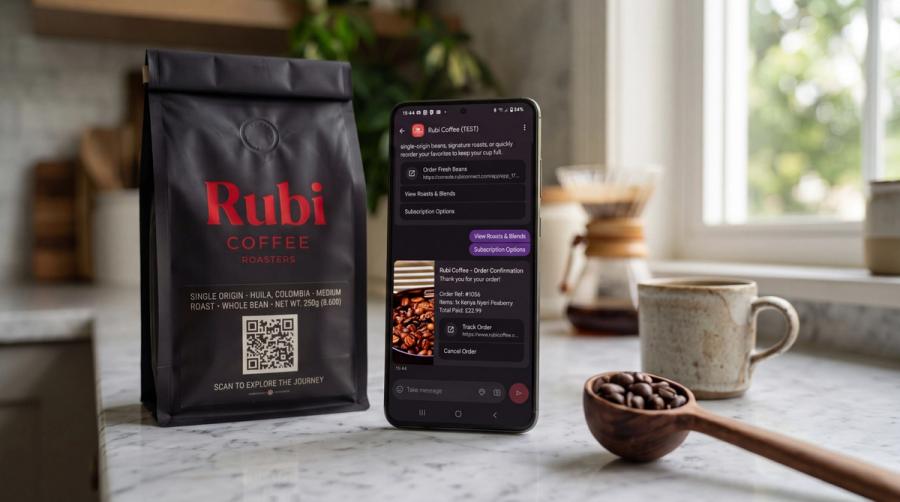
Conversational Commerce Without the Friction: The Rubi Coffee Playbook
How specialty roaster Rubi Coffee connected Shopify to WhatsApp and RCS with RubiApps to create a seamless, 24-second in-chat buying experience.
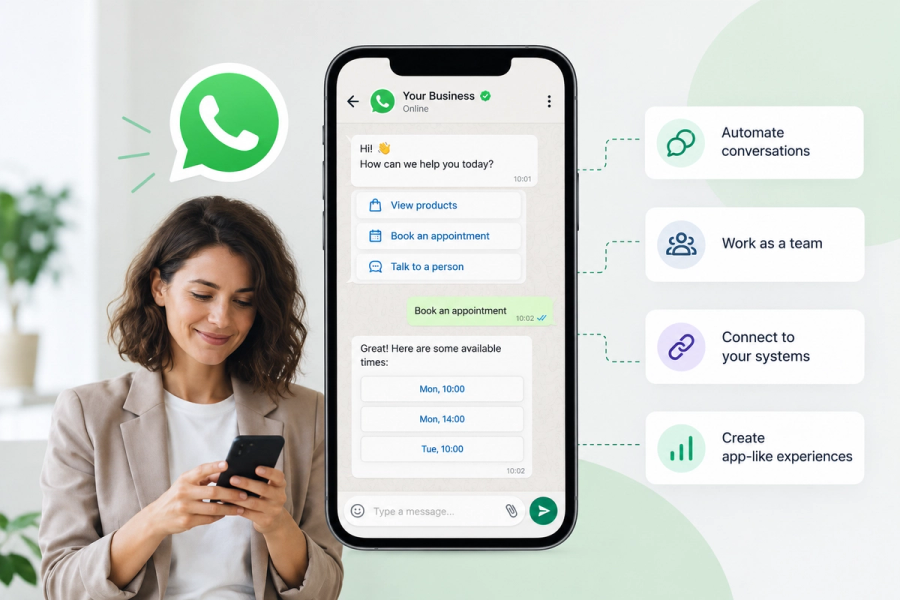
How to Get Started with WhatsApp Business in the UK: A Guide for SMEs
WhatsApp Business is easy to start with. But when your business wants to automate conversations, connect WhatsApp to its systems or create app-like customer experiences, the WhatsApp Business API opens up a whole new set of possibilities. This guide explains how to get started and what to look for in a WhatsApp Business provider in the UK.