Automating Invoice Controls and Debt Recovery for UK Small Businesses
For small and medium-sized enterprises across the United Kingdom, protecting cash flow has become a critical operational metric as B2B payment delays strain monthly liquidity. While standard email reminders increasingly trap in administrative spam filters, forward-thinking brands are moving financial alerts to mobile text infrastructure to accelerate settlement cycles.

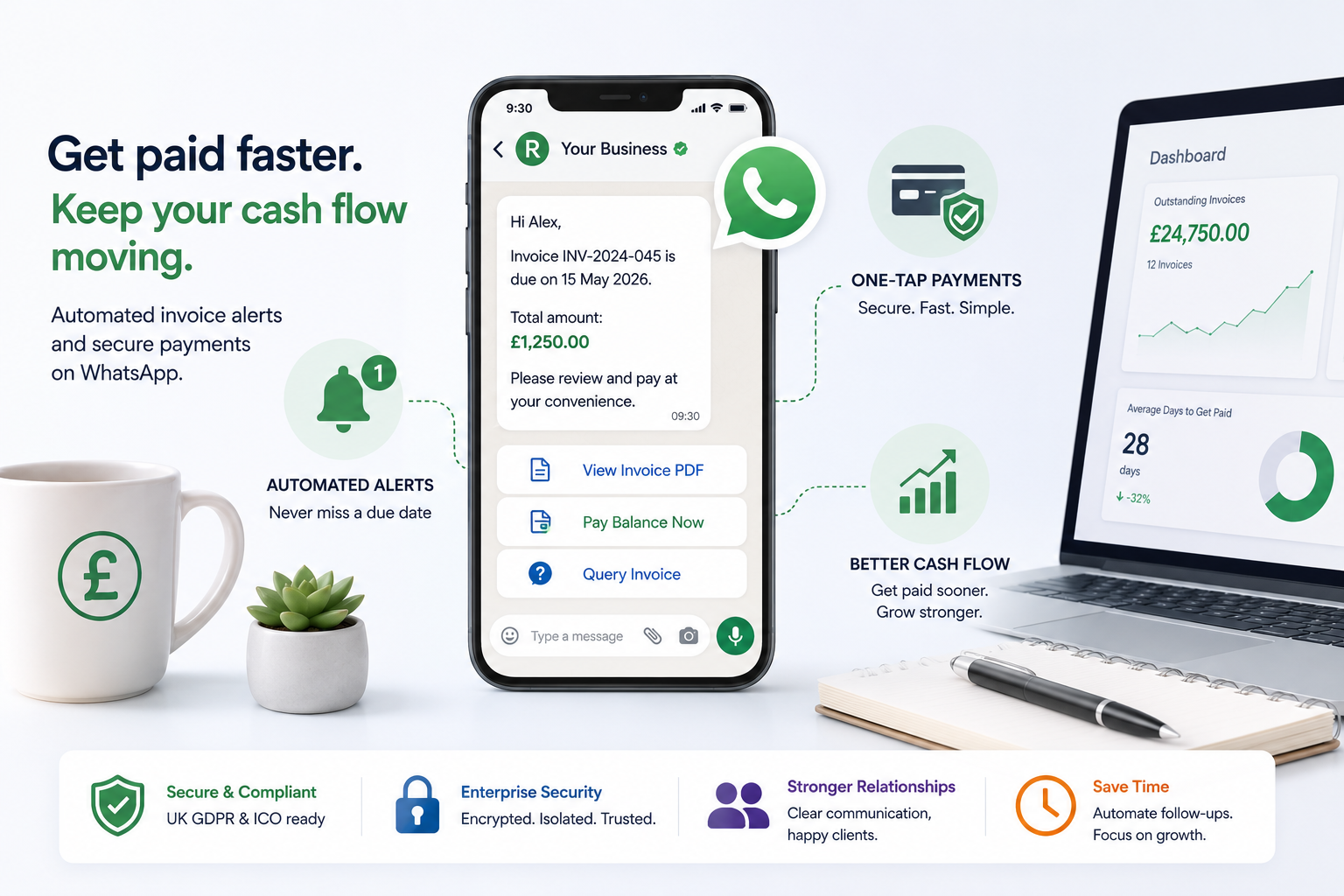
For any small or medium-sized enterprise (SME) in the United Kingdom, protecting cash flow is the defining metric of business survival. Amid persistent economic shifts and tightening supply chains, the UK market faces a chronic corporate pain point: late commercial payments between businesses.
Manually tracking bank reconciliations, chasing outstanding debts over email, or making uncomfortable collection calls consumes valuable hours that a lean administrative team simply does not have. Moreover, B2B email channels are oversaturated—causing critical payment reminders to get buried in client spam folders or ignored altogether.
To accelerate invoice settlement times without jeopardizing client relationships, UK SMEs are migrating to automated Transactional Treasury Notifications. By deploying RubiConnect as an intelligent infrastructure middleware layer, small businesses can connect their accounting software directly to WhatsApp, shifting debt collection to the communication channel with the highest open rate in the country.
Why Traditional Debt Collection Fails UK SMEs
Late payments in the UK B2B sector are rarely driven by immediate insolvency; they are primarily a symptom of operational friction and visibility gaps:
- The Email Dead-End: Automated accounting emails sent from billing systems frequently trip corporate security spam filters, meaning invoice managers often miss the payment alert entirely.
- Payment Execution Barriers: If an invoice reminder does not provide an immediate friction-free way to settle the balance, busy accounts-payable staff postpone the manual bank transfer (CHAPS/BACS) until their next end-of-month processing cycle.
- Lack of Open-State Trazability: SME administrative departments cannot verify if a client has actually seen a reminder, forcing teams to make repetitive phone calls blindly.
The Solution:
Automated Invoice Alerts and Asynchronous Collection via RubiConnect
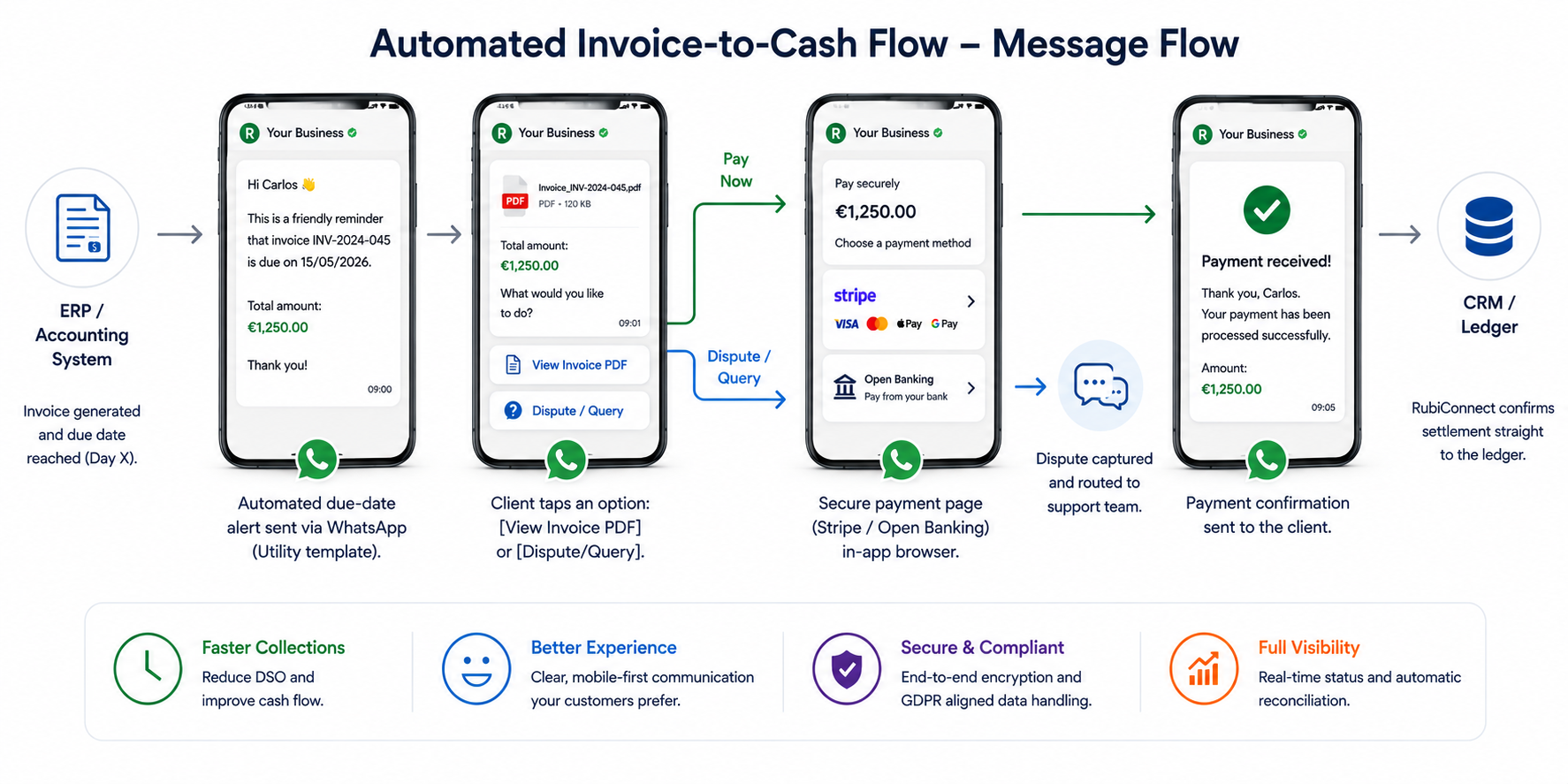
Implementing a transaction-focused messaging pipeline turns a manual administrative task into an automated, fluid workflow. By routing the WhatsApp Business API through RubiConnect and linking it straight to your cloud accounting stack (such as Xero, QuickBooks, Sage, or custom billing nodes), the recovery process is optimized from end to end:
The Automated SME Invoice Collection Loop
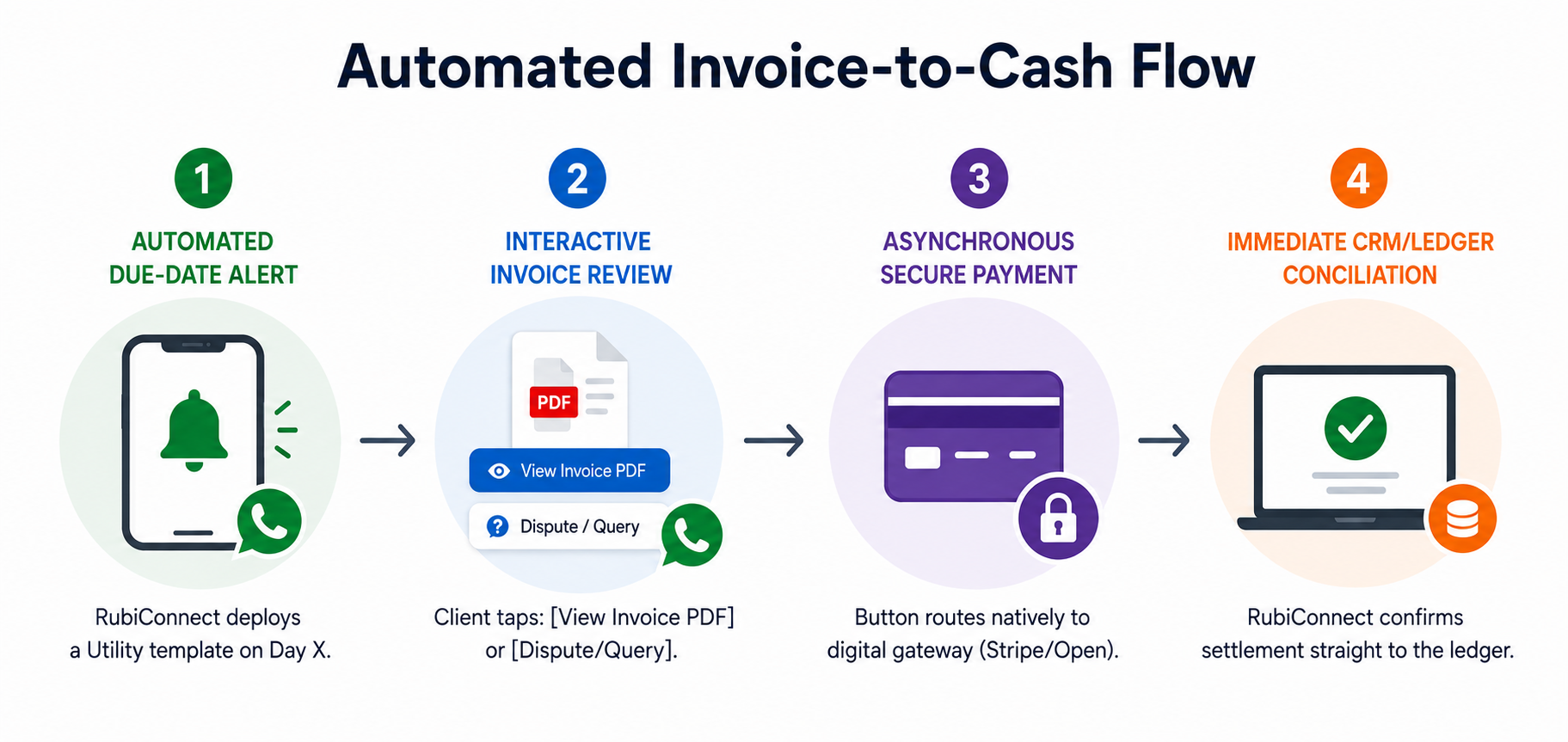
1. Low-Cost Utility Template Allocation
Meta explicitly categorizes payment notifications and invoice updates under Utility Templates. These operational triggers are billed at a significantly lower baseline rate in the UK market compared to promotional marketing broadcasts. This enables budget-conscious SMEs to deploy automated payment flows with minimal overhead and a massive return on liquidity.
2. One-Tap Quick Action Buttons
Rather than sending a block of unformatted text, RubiConnect structures the outbound alert with interactive, native UI components:
- [View Invoice PDF]: Natively pulls the live ledger document, allowing the client to verify line items in seconds directly on their mobile screen.
- [Pay Balance Now]: Links directly to your secure payment gateway token (e.g., Stripe, custom TPV virtual terminals, or Open Banking payment initiation apps), allowing the recipient to clear the debt immediately using corporate debit/credit profiles or instant bank-app authorization.
3. Structured Dispute Handling
If a client takes issue with a specific charge, they can tap a structured [Query Invoice] option. This immediately triggers an automated, conversational triage loop where the customer selects the issue category, logging the dispute back into your CRM via RubiConnect so your finance team can resolve the mismatch before it freezes the whole payment cycle.
Data Protection and Compliance: Meeting ICO Standards
Communicating corporate financial states or balancing outstanding account books in the UK requires strict adherence to data protection laws monitored by the Information Commissioner’s Office (ICO) and UK GDPR.
- The Lawful Basis of Contractual Necessity: Unlike promotional marketing blasts, outbound alerts regarding legitimate outstanding debts or payment collections operate under a firm lawful framework: the performance of a contract or legitimate business interest. A promotional Double Opt-In is not legally required to issue an invoice collection text, provided the communication channel is explicitly stated within your primary B2B terms of business.
- Data Minimisation & Infrastructure Isolation: RubiConnect is built with enterprise-level security protocols. The platform strictly serves as a secure, encrypted transport conduit that pipes variables directly between your verified enterprise ledger and Meta's official API node. Accounts data, bank details, and invoice totals are passed natively to your primary backend without being permanently cached in intermediate third-party databases, neutralizing compliance liabilities.
Stabilise Your SME Cash Flow Natively
Automating invoice collection pipelines allows small and medium-sized enterprises to compress their Debtor Days by up to 40% while freeing administrative staff from manual follow-up chains. With RubiConnect, your growing business can command the automated financial efficiency of an enterprise-grade corporate framework while maintaining a secure, modern customer experience.
Related Articles
Continue exploring more insights and guides
The Business Messaging Landscape in the UK: The Renaissance of the Native Inbox
The United Kingdom has established itself as one of the most mature, high-value, and compliance-driven digital economies in the world. As UK enterprises look to maximize customer lifetime value amid shifting economic conditions, the business messaging ecosystem is undergoing a dramatic paradigm shift. While in other countries the landscape is defined by near-total reliance on a single third-party application, the UK market is characterised by a fierce battle between over-the-top (OTT) ecosystems and the carrier-backed native inbox revival.

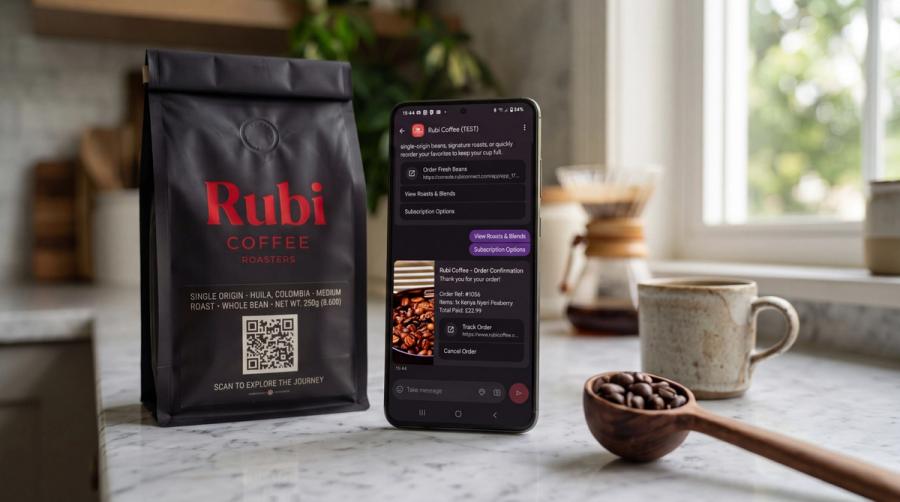
Conversational Commerce Without the Friction: The Rubi Coffee Playbook
How specialty roaster Rubi Coffee connected Shopify to WhatsApp and RCS with RubiApps to create a seamless, 24-second in-chat buying experience.
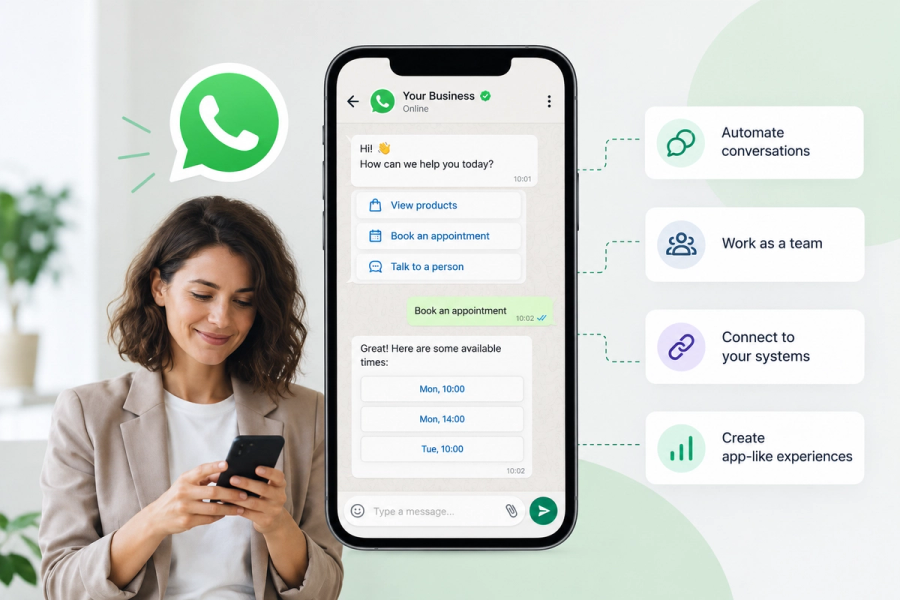
How to Get Started with WhatsApp Business in the UK: A Guide for SMEs
WhatsApp Business is easy to start with. But when your business wants to automate conversations, connect WhatsApp to its systems or create app-like customer experiences, the WhatsApp Business API opens up a whole new set of possibilities. This guide explains how to get started and what to look for in a WhatsApp Business provider in the UK.